
How to Budget When Your Income Changes
Read the practical guide and understand what to do with your estimate.
Plan steadily when income changes
Use recent tips, commissions, gig work, freelance income, seasonal pay, bonuses, or changing hours to compare your recent average with a more conservative Everyday Life Tools planning estimate.
 Free, private, and calculated on your device.
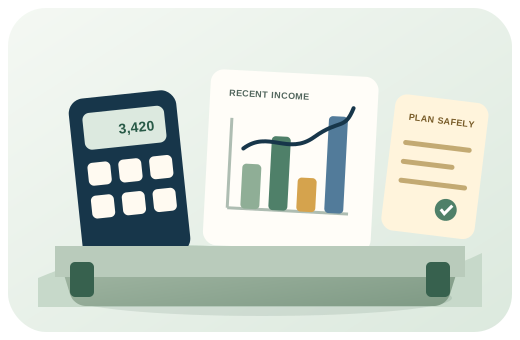
Calculate your income first, then choose a number to open or copy.
Your average shows the arithmetic average of the recent income amounts you entered.
The conservative planning number is an Everyday Life Tools methodology.
When you provide at least three income entries, the calculator averages the two lowest entries. With one or two entries, it uses the lowest amount entered.
That exact formula is not presented as an outside financial rule.
We use it to give you a second, more cautious number to compare with your recent average.
USU Extension separately describes the broader concept of using either lower recent income or average recent income when planning with irregular earnings. [S6]
For six biweekly incomes of $900, $1,200, $800, $1,000, $1,100, and $700, the average is $950. The lowest two average $750, so $750 is the conservative per-period planning number.
One way to use the result is to compare the average with the conservative planning number before deciding what amount feels realistic for recurring bills or spending commitments.
If the two numbers are close, your recent income may have been relatively steady.
If they are far apart, the difference can help you see how much your recent income has varied.
Income above the amount you choose to plan around could have different purposes depending on your circumstances, such as building a buffer, preparing for irregular expenses, saving, or covering flexible spending.
The calculator does not decide which number you must use.
Utah State University Extension discusses lower-income and average-income approaches for budgeting when income varies. [S6]
Everyday Life Tools interpretation: the calculator’s exact lowest-two formula is our own comparison method and should not be presented as an externally validated rule.
Helpful guides
Read the practical guide and understand what to do with your estimate.
Want to keep tracking your money after this estimate? The Calm Budget Sheet is a beginner-friendly Google Sheets budget tracker for ongoing planning.
View The Calm Budget SheetIn the future, you’ll be able to choose weekly, biweekly, or monthly checkup reminders.
Enter recent take-home income from equal-length pay periods. Include tips, commissions, gig or freelance pay, seasonal work, bonuses, or changing hours when they are part of what you received.
That is an Everyday Life Tools planning choice, not a universal financial rule.
When at least three periods are available, averaging the lowest two creates a cautious comparison number without making the entire estimate depend on only one low entry.
USU Extension discusses the broader idea of planning around lower recent income or an average when earnings vary, but the specific lowest-two formula is ours. [S6]
The calculator uses the lowest entered amount as the conservative planning number.
No. This calculator estimates an income number to plan around. Use the Paycheck Budget Calculator to allocate one actual paycheck.
This calculator is for general education and estimation only. It is not financial, legal, tax, or professional advice.